
A home blood pressure monitor can be useful, but do not start, stop, or change your blood pressure medicine based on a single unexpected reading. First, check how the measurement was taken. Were you sitting quietly for at least five minutes, or had you just climbed the stairs? Was the cuff placed directly on your bare upper arm rather than over clothing? Rest for five minutes, measure your blood pressure again, and record both readings.
For regular checks, use an automatic machine with a cuff around the upper arm. Take two readings about a minute apart at the times your doctor has advised. Feeling well does not rule out high BP; a headache does not prove you have it either.
Start with the cuff
When buying a machine online or at a medical store, ask whether it has been tested for accuracy. Check the cuff size too. The cuff supplied in the box may not fit every arm, and a poor fit can change the reading. Upper-arm machines are generally more dependable than wrist or finger devices.
Bring your machine to a clinic visit. A doctor or nurse can check how you place the cuff and compare it with their reading. If the machine is for someone who is pregnant or for a child, ask for a model suitable for them. Do not use a smartwatch reading in place of a cuff measurement.
Before you press start
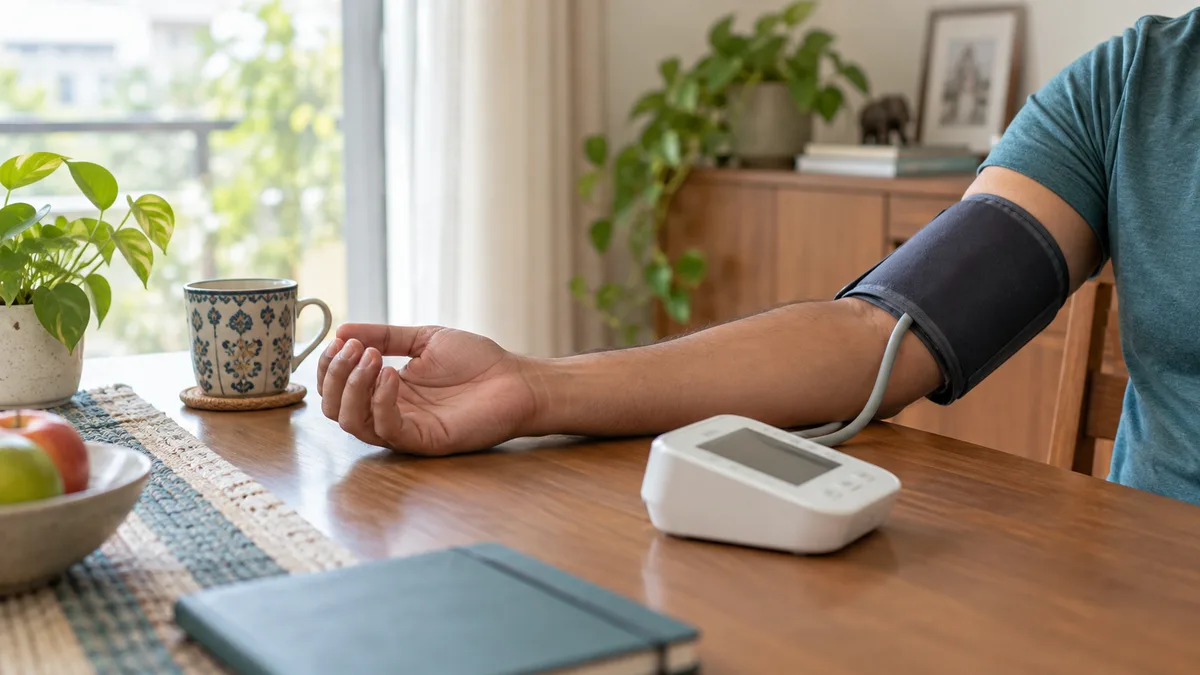
Avoid tea or coffee, smoking and exercise for 30 minutes before checking. Empty your bladder. Then sit with your back against the chair and both feet on the floor. Rest quietly for five minutes.
Put the cuff on your bare upper arm, just above the elbow. Rest that arm on a table at about the level of your heart. Do not talk or use your phone while the machine runs. Take a second reading about a minute later. Write down both; there is no need to keep checking until the display shows a number you prefer.
If a doctor has told you which arm to use, keep using that arm. Check at roughly the same times each day so that the readings are easier to compare.
How many readings should you keep?
If the aim is to find out whether BP is persistently high, a doctor may ask for morning and evening readings over several days. One commonly used plan is two readings each time for at least four days, ideally seven. The first day's readings are left out when working out the average under this plan. If you are checking how well your medicines are working, your doctor may give you a different schedule.
Keep the date, time and both numbers in a notebook or on your phone. Note anything unusual, such as pain or a missed dose. Bring that record to your appointment. Recalling only the highest number makes it harder to judge what has been happening.
What if the number is high?
The top number is the pressure when the heart pumps; the lower number is the pressure between beats. Both are measured in mm Hg. Some guidelines use an average home reading of 135/85 mm Hg or higher as a point for assessing high BP. It is an average, not a diagnosis from one reading or a universal treatment target. Your doctor may use a different target, especially if you have diabetes, kidney disease or other health concerns.
If your readings are repeatedly above the target your doctor gave you, make an appointment and take the record. Do not take an extra dose of your blood pressure medicine or stop it on the basis of one reading. Normal readings while on treatment may simply mean the treatment is working.
If the machine shows around 180/120 mm Hg or higher, wait a minute and check again. If it is still that high, contact a doctor immediately even if you feel well. Do not wait to complete a week of readings.
Chest pain, severe breathlessness, sudden weakness or numbness, trouble speaking, a sudden vision change, confusion or a sudden severe headache need emergency care now, whatever the machine says. Do not delay to take more readings. Chest discomfort should not be dismissed as gas while you wait.
If you are pregnant, ask your maternity team what readings and symptoms need urgent review. The adult home BP numbers above are not a pregnancy care plan.