
Many people do not check BP when they feel well. They check it when there is a headache, dizziness, sweating, anger, anxiety, or a heavy feeling in the head. If the reading is high that day, they say, "BP badh gaya tha." If there are no symptoms, they assume BP must be normal.
That is the main mistake.
High BP often has no clear symptoms. You can feel completely normal and still have blood pressure high enough to slowly damage the heart, brain, kidneys, and eyes. Headache, dizziness, or sweating may happen for many reasons, but they cannot confirm high BP. Feeling fine cannot rule it out. The only reliable way to know is to measure BP properly and repeat it when needed.
This is why doctors take BP seriously even when the patient says, "But I feel okay."
Why high BP can stay silent
Blood pressure is the force of blood pushing against the artery walls. When that pressure stays high over time, the body may not send an obvious alarm. There may be no pain, no fever, no visible swelling, and no dramatic symptom.
That silence is what makes high BP dangerous.
The arteries, heart, kidneys, brain, and eyes may still be under strain. The person may continue daily work, sleep normally, eat normally, and feel fit. Years later, the first visible problem may be a stroke, heart attack, kidney disease, heart failure, or eye damage. That is why hypertension is often called a silent condition.
For a patient, the practical translation is simple: BP is not a feeling. BP is a measurement.
Symptoms people wrongly use to judge BP
Some symptoms make people suspect BP immediately:
- headache
- heaviness in the head
- dizziness
- sweating
- anger or anxiety
- tiredness
- palpitations
- neck pain
- facial flushing
These symptoms deserve attention when they are severe, repeated, or unusual. But they are not specific to BP.
A headache may come from poor sleep, migraine, sinus trouble, fever, stress, eye strain, dehydration, or many other causes. Dizziness may come from low sugar, low BP, inner-ear problems, anemia, dehydration, medicine side effects, anxiety, or irregular heart rhythm. Weakness may come from poor intake, infection recovery, anemia, thyroid disease, diabetes, sleep loss, or stress. You can read more about that broader pattern in why persistent weakness should not be reduced to one quick explanation.
So the symptom may be real, but the conclusion may still be wrong.
When symptoms with high BP become urgent
There is a different situation where BP is very high and symptoms suggest possible organ strain. That should not be handled casually at home.
Seek urgent medical care if a very high BP reading comes with:
- chest pain, chest pressure, or severe breathlessness
- confusion, fainting, severe drowsiness, or fits
- weakness or numbness on one side of the body
- trouble speaking or sudden facial drooping
- sudden vision loss or severe visual blurring
- severe headache that is new, sudden, or unlike usual headaches
- repeated vomiting with severe headache or neurological symptoms
Chest discomfort is especially important because patients may confuse heart-related heaviness with acidity or gas. If that is a repeated doubt, read how chest burning can sometimes be acidity and sometimes a heart warning sign.
The point is not to panic over every reading. The point is to respect the combination of very high BP plus serious symptoms.
One high reading does not always mean lifelong BP
This is another common confusion.
BP can rise temporarily after rushing, climbing stairs, pain, anxiety, fever, poor sleep, smoking, caffeine, a full bladder, or talking during measurement. A tight cuff, wrong cuff size, unsupported arm, or measuring immediately after activity can also give a misleading number.
That is why doctors do not judge the whole diagnosis from one casual reading at a shop or one reading taken during panic. They look for properly measured, repeated readings and the full clinical context.
At the same time, do not ignore a high reading only because you were stressed. If readings remain high on repeat checks, it needs medical review.
How BP should be checked more reliably
Small measurement habits can change the number.
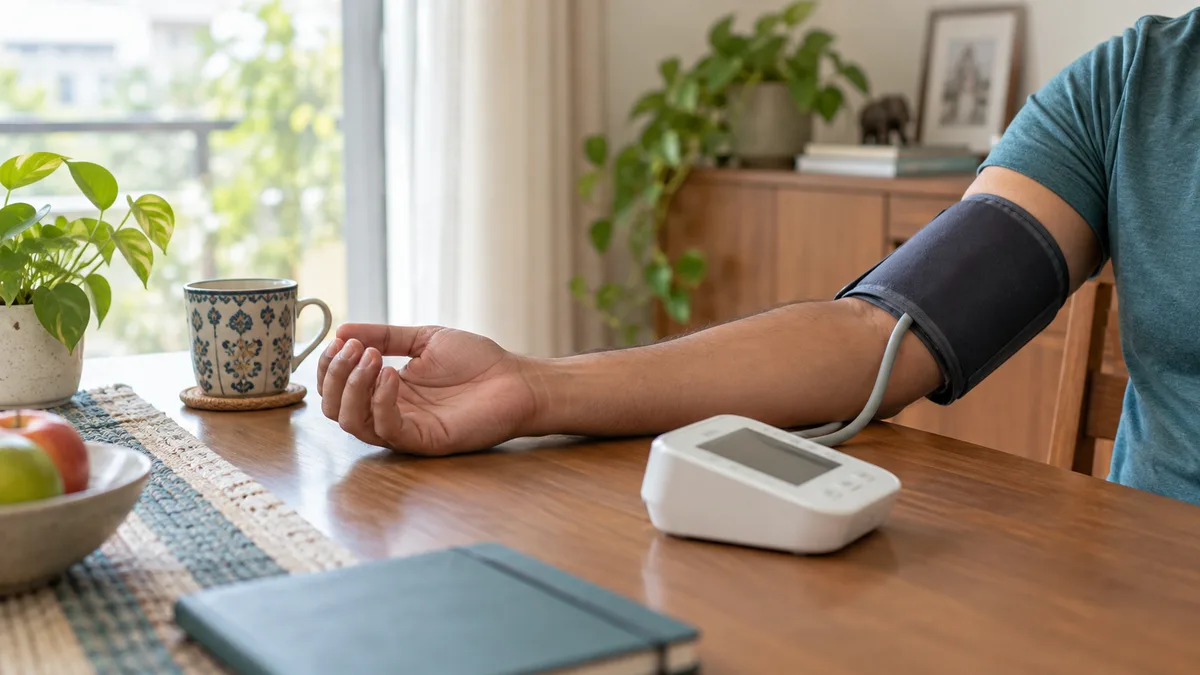
Before checking BP, sit quietly for about five minutes. Keep the back supported, feet on the floor, arm supported at heart level, and avoid talking during the reading. The cuff should fit the arm properly. If the first reading is high, repeating it after a short rest often gives a clearer picture.
Home BP machines can be useful, but the device should be reliable and used correctly. Wrist machines and poorly fitted cuffs can mislead. If home readings and clinic readings do not match, take the machine to the clinic once and compare technique.
Do not change or stop BP medicine only because one home reading looks better. BP control is judged over a pattern, not one lucky number.
Who should be more careful about silent BP
Regular BP checks matter more if you have:
- age above 30 to 40, especially with family history
- diabetes or borderline sugar
- kidney disease
- obesity or increasing waist size
- smoking or tobacco use
- high salt intake
- heavy alcohol use
- poor sleep or snoring
- high stress with little physical activity
- previous high readings during clinic visits
Some people discover BP only during a fever visit, dental visit, pregnancy check, insurance medical, or routine health camp. That discovery should not be dismissed. It is often the first useful clue.
What doctors are really trying to prevent
The goal is not to make a patient afraid of numbers. The goal is to prevent silent damage.
Long-standing high BP makes the heart pump against extra resistance. It can stiffen arteries, strain the heart muscle, damage kidney filters, raise stroke risk, and affect the blood vessels of the eyes. These changes happen slowly, so the patient may not feel them in the beginning.
That is why treatment discussions are not based only on whether the patient has a headache today. Doctors consider repeated BP readings, age, diabetes, kidney health, heart risk, lifestyle, medicines, and evidence of organ damage.
For some people, lifestyle changes are a major part of control. For others, medicines are needed. Many patients need both. The exact plan should come from a clinician who has checked the readings and the person's risk profile.
What to remember
High BP is common, but it should not be guessed from symptoms.
If you feel normal, your BP can still be high. If you have a headache, your BP may be normal. If one reading is high, repeat it correctly and discuss the pattern. If BP is very high with chest pain, breathlessness, confusion, one-sided weakness, severe headache, or vision trouble, treat it as urgent.
The safest habit is simple: measure BP properly, keep a record, and do not wait for the body to announce a silent problem.